Innerbody Labs Focus Support Review 2026
 James BevanUpdated November 2, 2026
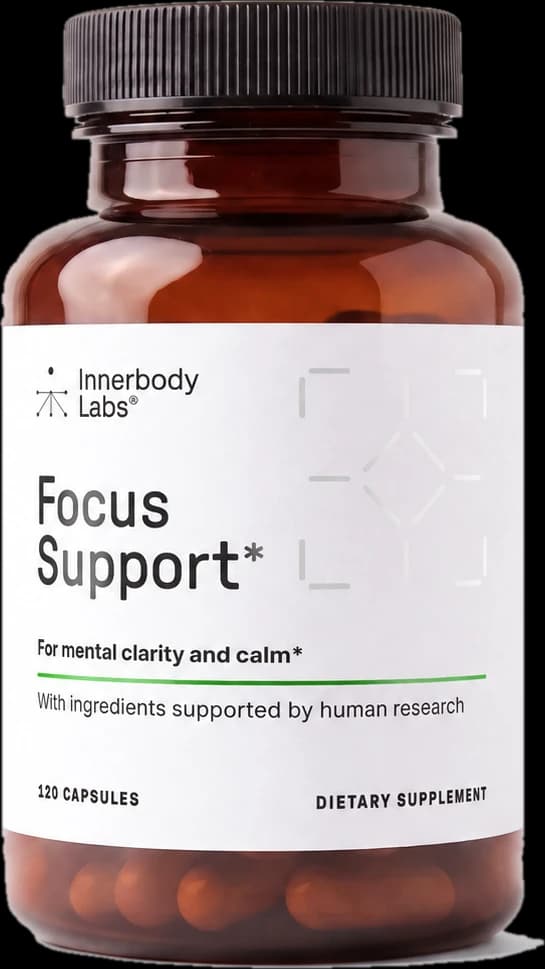
Focus Support is Innerbody Labs' 15-ingredient brain supplement, made by the same company that runs the innerbody.com review site, and it packs citicoline, rhodiola, ashwagandha and a little caffeine into four capsules. But are the doses really as research-backed as the label suggests, and what does the brand's own lab report show? To find out, we've checked every ingredient against the published studies, read that report and the refund terms, and looked at what buyers have to say.
Quick verdict
Our scientific audit
Buyer rating
- Price per serving$2.97
- Doses in range5 of 10
- Caffeine80 mg
- Money-back guarantee30 days
- Third-party testingPartly, one 2025 batch posted
- Servings per bottle30
Costs $3.84 a day less than buying these ingredients as separate bottles at the doses studies used. See the list.
Better-rated alternatives
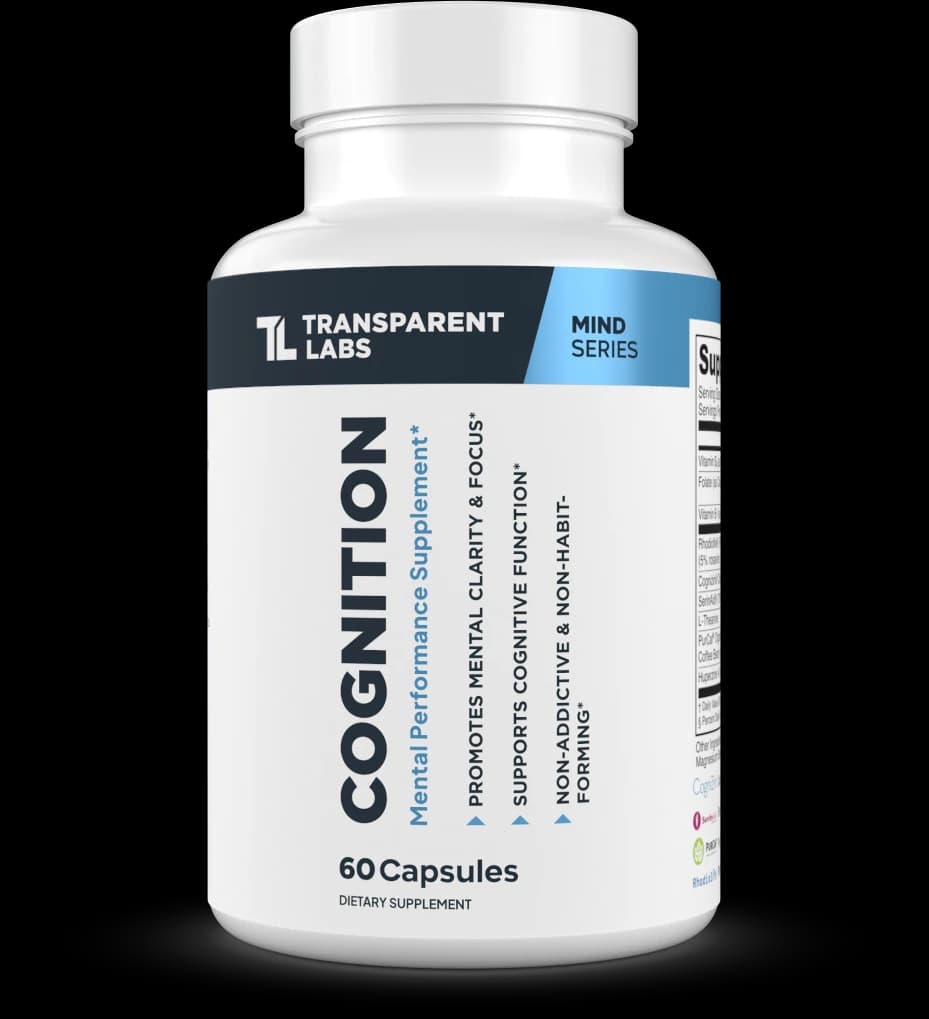 Transparent Labs CognitionScientific auditScientific audit 7.8/10Buyer ratingBuyer rating 9.7/10
4 of 6 ingredients at studied amounts
Shares 5 ingredients with Focus Support
Check price$1.67 a day
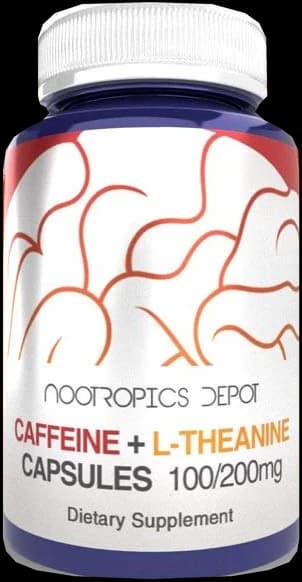 Caffeine + L-Theanine 100 mg / 200 mg CapsulesScientific auditScientific audit 9.4/10Buyer ratingBuyer rating 8.8/10
2 of 2 ingredients at studied amounts
Shares 2 ingredients with Focus Support
Check price$0.33 a day
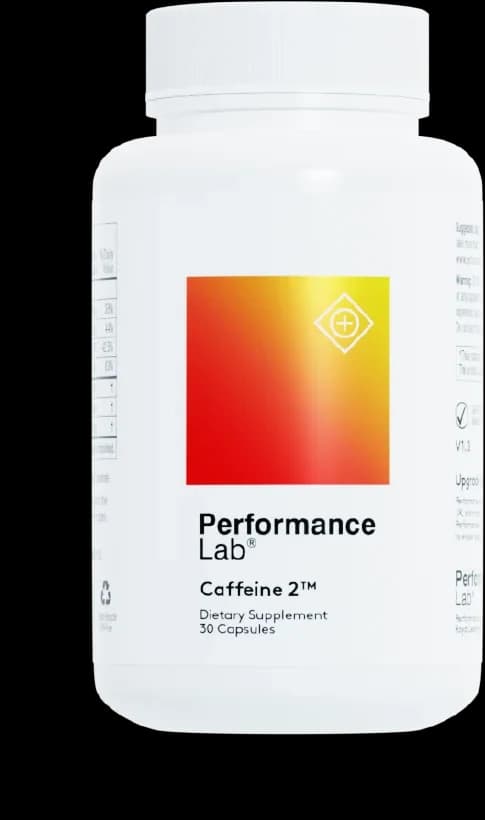 Caffeine 2Scientific auditScientific audit 7.2/10Buyer ratingBuyer rating 8.8/10
2 of 3 ingredients at studied amounts
Shares 3 ingredients with Focus Support
Check price$1.47 a day
We may earn a commission from links on this page, at no extra cost to you. How we make money
In this review
What's good, and what isn't
Pros
- Five of the ten ingredients we score get full credit, including 500 mg of Cognizin citicoline and 350 mg of rhodiola, and saffron and PQQ reach their study amounts too
- A posted report from an ISO 17025 accredited lab measured six of the main ingredients, plus metals, microbes and pesticides
- One-time orders can be returned within 30 days of delivery even if the bottle is part used
Cons
- 200 mg of N-acetyl-L-tyrosine is about a tenth of the 2,000 mg tyrosine dose in its studies, and in the drip studies we found, that form raised blood tyrosine little
- The only lab report is from a 2025 batch, and it measured caffeine, theanine and PQQ at 91, 86 and 73 percent of the label
- The subscription policy says subscription charges aren't refundable, which contradicts the 30-day guarantee
Why Focus Support scored 6.5 out of 10 in our scientific audit
- Dose fit40%66
Five of the ten actives earn full credit. Saffron and PQQ reach their study doses but get half credit because the label doesn't name the studied forms, and phosphatidylserine gets half because the brand's "50%" wording leaves its real amount unclear. Tyrosine is about a tenth of 2,000 mg and lion's mane 100 mg against 1,800 mg. The B vitamins aren't scored.
- Evidence30%45
Each ingredient's evidence counts in proportion to its dose credit, so the half credits for saffron, PQQ and phosphatidylserine halve their evidence too. Citicoline, lion's mane and PQQ also have early-stage evidence.
- Transparency20%90
Every amount is printed and nothing sits in a blend. It loses a few points because we read the label from the brand's site, and because the old and new labels and the product page disagree on B6, phosphatidylserine and rhodiola.
- Testing10%70
A full report from Certified Laboratories, an ISO 17025 accredited lab, is posted for one batch, but it's from 2025 and no newer batch has a report.
Worked out under method audit-v2.0. How the rating is built
Score history
Nov 2, 2026 First audit published (6.5)
We checked the label, compared each dose with the human research and published the review.
6.5 is a fair score, though the formula is better than the number makes it look. Seven of the ten ingredients we score, including citicoline, rhodiola and ashwagandha, reach the amounts their studies started from, which is rare in a 4-capsule formula. Only five of them get full credit, though. Saffron and PQQ reach their amounts, but the label doesn't say they're the forms that were tested, so each gets half credit, and the phosphatidylserine does too because the brand's own wording leaves its real amount in doubt. The two real misses are tyrosine, at a tenth of its benchmark, and lion's mane, a small extract the research hasn't tested.
The evidence bar takes the same half credits, and citicoline, lion's mane and PQQ rest on small or early research anyway. Testing is held back by age rather than effort. Innerbody Labs posts a full report from a named, accredited lab, but it covers one batch made in 2025, and a current report that measured every active ingredient would add about 0.3 to the score.
The claims, checked
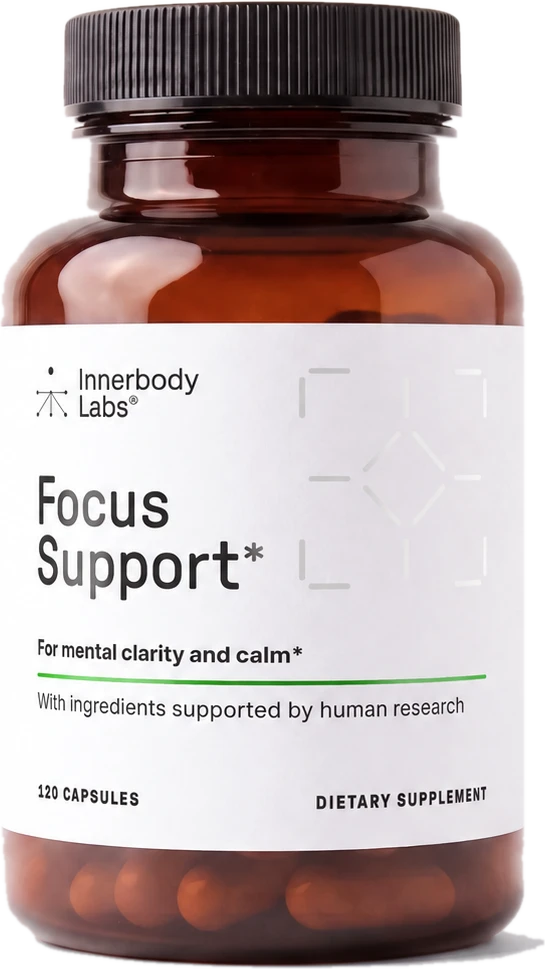

The label lists 15 ingredients in a 4-capsule serving, with 30 servings in a 120-capsule bottle, and the main amounts haven't changed since the product launched in 2025.12 The bottle has since been redesigned, and the gallery says the old one is still shipping with the "SAME FORMULA," so you may get either label. They differ only in the B6 line and the "50%" after phosphatidylserine.3
There's no warning or direction text in the label image, and the product page doesn't carry a pregnancy warning either. The only dosing advice is in the FAQ, which suggests taking all four capsules in the morning, or two and two before noon, and nothing after 2 pm because of the caffeine.4 The product page also has a heading that gives the rhodiola as "350 mcg," when the label and the text under it both say 350 mg.
“Supports attention, mental clarity, and stress resilience, using clinically studied ingredients at research-aligned doses.”
PartlyFor seven of the ten ingredients we score, the amounts match, and that's more than most brain supplements can say. The other three don't fit the line. Tyrosine is a tenth of the amount its research used, lion's mane is an extract no trial has tested, and the phosphatidylserine depends on how you read "50%." Several of the matches are also looser than they look. The rhodiola and ashwagandha studies used different extracts from the ones on this label, the saffron and PQQ aren't named as the forms that were tested, and the best-known KSM-66 trial gave twice as much.567
“Third-Party Testing on Every Batch. With posted results you can access.”
PartlyThere is a real report, and it's better than most. Certified Laboratories in Tustin, California, an ISO 17025 accredited lab, tested batch 2517855 in 2025. It measured six of the ten main ingredients and all five B vitamins, found metals only at trace levels, and found no harmful microbes or pesticide residues.8 Citicoline came in at 113 percent of the label and phosphatidylserine at 120 percent, but caffeine was at 91 percent, theanine at 86 percent and PQQ at 73 percent. Rhodiola, ashwagandha, lion's mane and saffron were only checked for identity, not amount.
What you can't access is a report for any other batch. The brand's results page lists that one batch for Focus Support,9 so "every batch" may well be true, but only one set of results is posted, and it's more than a year old.
“we use a potent, 20:1 extract, which delivers the equivalent of 2g of lion's mane mushroom per serving”
Doesn't hold upThe ratio means about 2 g of mushroom went into making the 100 mg, so the number isn't invented. What doesn't follow is that 100 mg of extract does what 2 g of mushroom did in the trials. Those studies gave 1.8 g a day of a lion's mane mushroom blend to healthy adults and about 3 g a day of dried fruiting body to older adults with mild cognitive impairment,1011 and an extract keeps some of the mushroom's compounds and loses others. We found no trial of a lion's mane extract at this dose, so "equivalent" is a guess.
“30-Day Money Back Guarantee”
PartlyFor a one-time order, this is one of the better refund policies we've seen. You have 30 days from delivery, the brand takes back bottles "even if it has been partially used," and you're refunded once they arrive, although you pay the return postage.12 The subscription policy says something different, though, that "All product and subscription charges are non-refundable,"13 and the two pages don't explain which wins. International orders are final sale.
What's inside, audited
10 ingredients checked, 5 within range, 2 short, 3 above the range or at half credit.
Within range (citicoline, rhodiola, ashwagandha, L-theanine, caffeine). Short (L-tyrosine, lion's mane). Above the range or at half credit (phosphatidylserine, saffron, PQQ).
Cognizin · Preliminary evidence
Doses used in studies that showed a benefit
Focus Support has 500 mg, the highest daily dose used in studies that showed a benefit.14
Study dose benchmark from McGlade 2012, 250 or 500 mg a day, 28 days14
Citicoline is the headline ingredient, and at 500 mg of Cognizin it's twice 250 mg, the study dose we use as its benchmark. The brand leans on a trial in 100 adults aged 50 to 85 with age-related memory complaints, where 500 mg a day for 12 weeks improved episodic memory and an overall memory score.15 What the product page doesn't say is that the trial's main outcome, a spatial memory test, didn't separate from placebo, and Kyowa, the company that makes Cognizin, paid for it. In the earlier trial in 60 women, 500 mg did no better than 250 mg.14
Rhodiolife root extract, 5% rosavins, 1.8% salidroside · Moderate evidence
Doses used in studies that showed a benefit
Focus Support has 350 mg, inside the 170 mg to 680 mg used in studies that showed a benefit.5
Study dose benchmark from Darbinyan 2000, 170 mg a day, 2 weeks5
Rhodiola comes in at 350 mg of Rhodiolife, comfortably above 170 mg, and inside the 340 to 680 mg range used in a six-week trial in people with mild to moderate depression.516 The catch is that those trials used a different extract, SHR-5, and we found no published trial of Rhodiolife on its own, so the dose matches the research more closely than the extract does.
source not stated; the product page says 'Phosphatidylserine 50%' · Moderate evidence
Doses used in studies that showed a benefit
Focus Support has 300 mg, the daily dose used in studies that showed a benefit, but the label doesn't confirm the form or extract those studies tested, so it earns half credit.17
Study dose benchmark from Crook 1991, 100 mg three times a day, 12 weeks17
Phosphatidylserine is the one we can't pin down. The new label says 300 mg. The older bottles, which the brand says are still shipping, print "Phosphatidylserine 50%," though, and in the supplement trade that usually means a powder that's half phosphatidylserine by weight, which would be 150 mg.1318 The brand's 2025 lab report measured 360 mg a serving, which points to the full amount, so it may just be confusing wording. Until the brand says so, the score gives it half credit. The positive 300 mg trial also used phosphatidylserine from cow brain, while a 300 mg trial of the soy kind in older adults found no difference from placebo.1719
KSM-66 organic root extract · Moderate evidence
Doses used in studies that showed a benefit
Focus Support has 300 mg, the lowest daily dose used in studies that showed a benefit.6
Study dose benchmark from Gopukumar 2021, 300 mg once a day, 90 days6
Ashwagandha is 300 mg of KSM-66, right on our 300 mg benchmark, which comes from a 90-day trial in 130 stressed adults that improved recall and lowered stress scores.6 That trial used a different extract, though, a sustained-release capsule called Prolanza, and the best-known KSM-66 trial gave 300 mg twice a day.7 So Focus Support has half the KSM-66 that trial used.
N-acetyl-L-tyrosine (NALT) · Moderate evidence
Doses used in studies that showed a benefit
Focus Support has about 162 mg (200 mg N-acetyl L-tyrosine on the label). The study dose we use as this ingredient's benchmark is 2,000 mg, so it's 1,838 mg short.20
Study dose benchmark from Colzato 2013, 2,000 mg, single dose20
Tyrosine is the biggest miss. The 200 mg of N-acetyl-L-tyrosine works out at about 162 mg of tyrosine, against the 2,000 mg single dose in the trial we use as its benchmark.20 It's also a form that may not deliver much. In the human studies we found, all given by drip, the acetylated form raised blood tyrosine by a quarter at most, and 35 to 60 percent of it came straight out in urine.212223
L-theanine · Moderate evidence
Doses used in studies that showed a benefit
Focus Support has 160 mg, between the 100 mg single dose and the 400 mg a day used in studies that showed a benefit.24
Study dose benchmark from Dassanayake 2023, One dose of 100, 200 or 400 mg24
from Coffeeberry Energy whole coffee fruit extract · Strong evidence
Doses used in studies that showed a benefit
Focus Support has 80 mg, between the 40 and 300 mg single doses used in studies that showed a benefit.25
Study dose benchmark from McLellan 2016, about 40 to 300 mg a dose, across the trials it reviews25
Theanine and caffeine are where the formula is easiest to feel. 160 mg of theanine with 80 mg of caffeine is the 2:1 ratio the brand mentions, and the brand compares the caffeine to a single espresso. Both are well above 100 mg and 40 mg, our benchmarks.2425 Nobody has tested exactly 160 mg with 80 mg. The nearest trial gave 20 men 200 mg of theanine, 160 mg of caffeine or both, and each of the three sped up responses on an attention task, with the pair doing about what you'd expect from adding the two together.26 The 2025 lab report found a little less of both than the label, 137 mg and 73 mg, which still clears both benchmarks.8
20:1 fruiting body extract · Preliminary evidence
Doses used in studies that showed a benefit
Focus Support has 100 mg. The study dose we use as this ingredient's benchmark is 1,800 mg, so it's 1,700 mg short.10
Study dose benchmark from Docherty 2023, 1.8 g, one dose and then 28 days10
Lion's mane is 100 mg of a 20:1 extract, and the product page says that "delivers the equivalent of 2g of lion's mane mushroom."4 That's the arithmetic of the ratio, not something a trial has checked. The human studies used 1 to 3 g a day of mushroom product rather than an extract, including 1.8 g of a lion's mane blend in the trial we use as the benchmark.10 We found none that tested an extract at 100 mg, so we score the 100 mg on the label.
flower extract, 2% safranal · Moderate evidence
Doses used in studies that showed a benefit
Focus Support has 30 mg, the highest daily dose used in studies that showed a benefit, but the label doesn't confirm the form or extract those studies tested, so it earns half credit.27
Study dose benchmark from Lopresti 2025, 28 mg a day, 12 weeks27
pyrroloquinoline quinone · Preliminary evidence
Doses used in studies that showed a benefit
Focus Support has 20 mg, the lowest daily dose used in studies that showed a benefit, but the label doesn't confirm the form or extract those studies tested, so it earns half credit.28
Study dose benchmark from Itoh 2016, 20 mg a day, 12 weeks28
Saffron and PQQ reach their benchmarks on paper but get half credit each, because the label doesn't name the forms the trials used. The 30 mg of saffron compares with 28 mg of affron, which lowered depression scores in a 12-week trial in 202 adults with mild low mood,27 but the label only says "Saffron Extract" at 2% safranal. PQQ is 20 mg, the dose of BioPQQ in a 12-week trial in 41 older adults that found a small benefit on an attention test,28 and the label just says PQQ. The lab also measured 14.65 mg of it, about three quarters of the label.8 Both trials were run with the makers of those ingredients.
Also on the label are vitamin B3 16 mg, vitamin B6 1.7 mg, folate 400 mcg, vitamin B12 2.4 mcg, vitamin B5 5 mg. These have no cognitive dose range for people who aren't deficient, so they don't count toward the formula score.
The five B vitamins are roughly 100 percent of the daily value each, so they're there as nutrition rather than as focus ingredients. One small oddity is that the new label gives B6 as 1.7 mg at "118%" of the daily value, which is the figure for 2 mg, the amount on the old label and in the lab report's specification.18
To be fair to Innerbody Labs, every amount is printed, the doses are high for a 4-capsule serving, and the misses are visible on the label rather than hidden in a blend.
Compare it yourself
Focus Support against its closest matches
| Product | Focus SupportThis review | 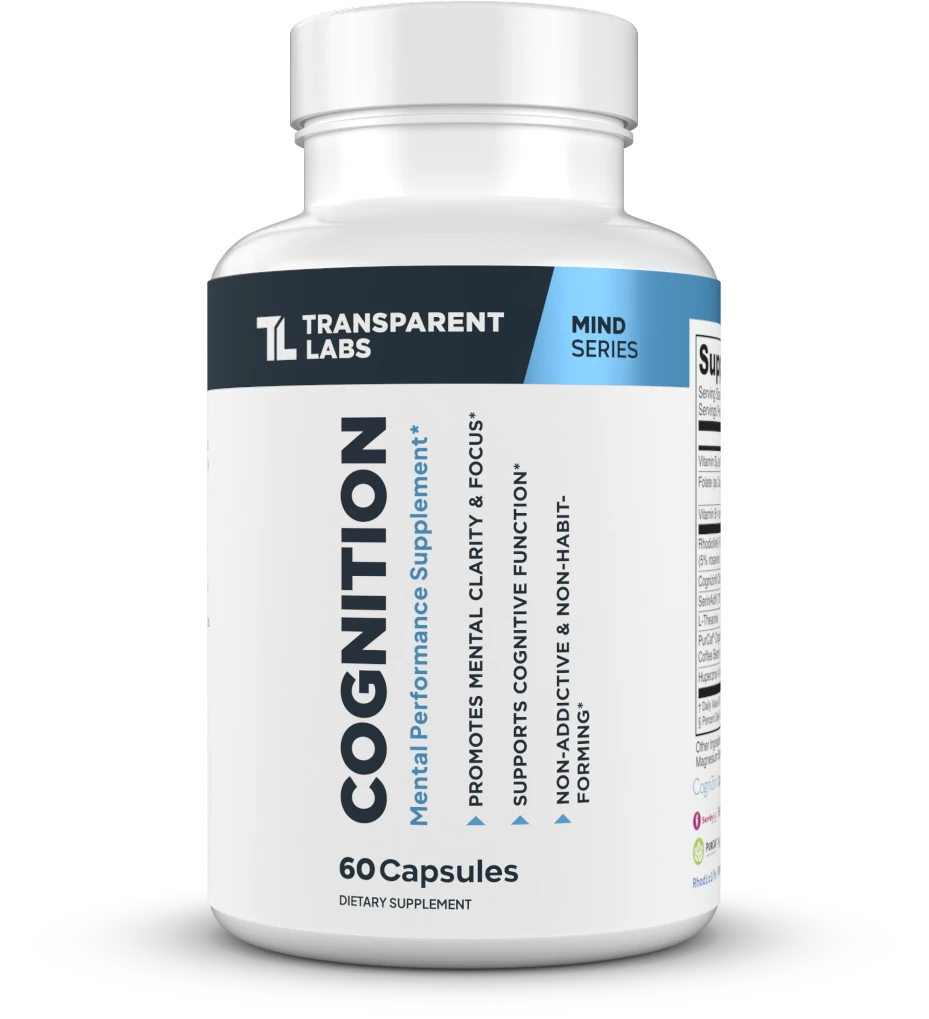 Transparent Labs Cognition | 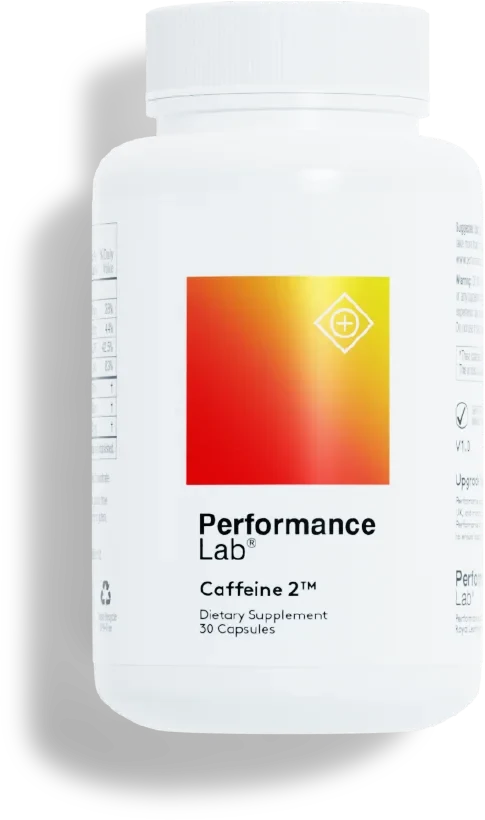 Caffeine 2 | 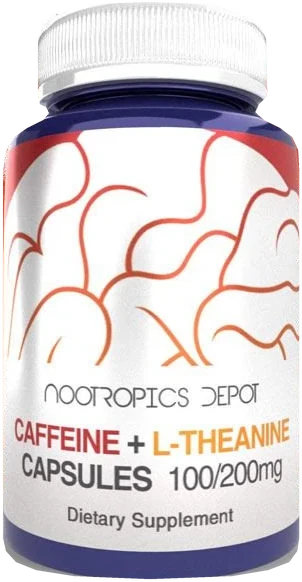 Caffeine + L-Theanine 100 mg / 200 mg Capsules |
|---|---|---|---|---|
| Scientific audit | 6.5/10 | 7.8/10 | 7.2/10 | 9.4/10 |
| Buyer rating | 9.2/10 | 9.7/10 | 8.8/10 | 8.8/10 |
| Price per serving | $2.97 | $1.67 | $1.47 | $0.33 |
| Doses of Focus Support's ingredients | ||||
| Citicoline | 500 mgCognizinAt or above the study dose benchmark | 250 mgCognizinAt or above the study dose benchmark | Not in formula | Not in formula |
| Rhodiola Rosea | 350 mgRhodiolife root extract, 5% rosavins, 1.8% salidrosideAt or above the study dose benchmark | 600 mgRhodiolife, 5% rosavins, 1.8% salidrosideAt or above the study dose benchmark | Not in formula | Not in formula |
| Ashwagandha | 300 mgKSM-66 organic root extractAt or above the study dose benchmark | Not in formula | Not in formula | Not in formula |
| L-Tyrosine | 162 mg200 mg N-acetyl L-tyrosine on the label1,838 mg below the study dose benchmark | Not in formula | 250 mgL-tyrosine (the page copy says Ajipure)1,750 mg below the study dose benchmark | Not in formula |
| L-Theanine | 160 mgL-theanineAt or above the study dose benchmark | 100 mgAt or above the study dose benchmark | 100 mgL-theanineAt or above the study dose benchmark | 200 mgL-theanineAt or above the study dose benchmark |
| Lion's Mane Mushroom | 100 mg20:1 fruiting body extract1,700 mg below the study dose benchmark | Not in formula | Not in formula | Not in formula |
| Caffeine | 80 mgfrom Coffeeberry Energy whole coffee fruit extractAt or above the study dose benchmark | 100 mgPurCaf organic caffeine from green coffee beanAt or above the study dose benchmark | 50 mgnatural caffeine from Coffea robusta seedsAt or above the study dose benchmark | 100 mgcaffeine (anhydrous per the product page)At or above the study dose benchmark |
| Phosphatidylserine | 300 mgsource not stated; the product page says 'Phosphatidylserine 50%'Half credit | 140 mgSerinAid (200 mg at 70% phosphatidylserine)160 mg below the study dose benchmark | Not in formula | Not in formula |
| Saffron Extract | 30 mgflower extract, 2% safranalHalf credit | Not in formula | Not in formula | Not in formula |
| PQQ | 20 mgpyrroloquinoline quinoneHalf credit | Not in formula | Not in formula | Not in formula |
The products that share the most cognitive ingredients with Focus Support are shown first. Any product sharing at least two can be added.
The nearest match is Transparent Labs Cognition, which shares the citicoline, rhodiola, phosphatidylserine, theanine and caffeine, including the same Rhodiolife extract at 600 mg. It scores higher and costs $1.67 a serving, but it has no ashwagandha, saffron or PQQ, so Focus Support covers more ground for the extra money. If it's mainly the caffeine and theanine you're after, Nootropics Depot's Caffeine + L-Theanine has 100 mg of caffeine and 200 mg of theanine for 33 cents, a fraction of the price. And if you'd rather skip the caffeine altogether, Mind Lab Pro has citicoline, rhodiola, phosphatidylserine and lion's mane with none.
Price and where to buy
Focus Support is sold only on Innerbody Labs' own site, and we didn't find it at Walmart or iHerb. A one-time bottle costs $89.00, which is $2.97 a serving, and it ships free at that price.429 A monthly subscription takes 24 percent off and a 3-month plan takes off more. That's not cheap, but buying the same ten ingredients at their study amounts as separate bottles costs more than twice as much.
- innerbodylabs.com direct
- Listed price
- $89.00
- Per serving
- $2.97
- Status
- In stock
What studied amounts cost separately
This prices the ten ingredients we score as separate bottles at the amounts their studies started from, which for tyrosine means 2,000 mg and for lion's mane 1.8 g.
L-tyrosine 2,000 mg
NOW Foods L-Tyrosine 750 mg, Extra Strength Capsules (not sold on the brand's site)
3 capsules of 750 mg, rounded up
Lion's mane 1,800 mg
3 capsules of 700 mg, rounded up
Caffeine 40 mg
1 capsule of 100 mg, rounded up
Bought separately
$6.81 a day
$204.24 for 30 servings
Focus Support at innerbodylabs.com
$2.97 a day
$89.00 for 30 servings
Buying separately costs $3.84 a day more ($115.24 for 30 servings).
This is one stack where buying separately costs more, and by a long way. The separate bottles come to more than twice Focus Support's one-time price, with the phosphatidylserine alone making up about half of it. Even leaving that out, the other nine cost a little more than a serving of Focus Support, so on price the one bottle wins, and it's four capsules instead of 16.
What other reviewers say
We couldn't find an independent review of Focus Support with a score we could use. The most prominent one is on innerbody.com, which belongs to the same company, Innerbody Research. It rates Focus Support 4.7 out of 5 and ranks it the best nootropic overall, and the review itself describes writing about it as "an apparent conflict of interest."3031 The other pages that rank for the product's name mostly describe a different formula, listing ingredients such as bacopa and huperzine A that Focus Support doesn't contain.
What buyers report
Safety notes
The caffeine is modest at 80 mg a serving, about one espresso, but count it alongside your coffee and take the capsules in the morning, as the brand suggests. In one trial, 400 mg of caffeine taken six hours before bed still cut total sleep by more than an hour.32 The FDA cites 400 mg a day as the most not generally linked with harm in healthy adults.33
Ashwagandha is the ingredient with the most to be careful about. Rare cases of liver injury have been reported. All five people in a case series from Iceland and the US recovered, but three people with existing liver disease died in a series from India.3435 The NIH advises avoiding it in pregnancy and while breastfeeding, and says it isn't recommended if you have a thyroid or autoimmune condition.36 Tyrosine can also interact with MAO inhibitor antidepressants and thyroid medication, and Spain's medicines agency warns that citicoline strengthens the effect of levodopa.373839 The product page carries no pregnancy warning, so if you're pregnant, breastfeeding, taking medication or managing a health condition, check with your doctor first. We're researchers, not doctors.
Final thoughts
Focus Support gets more right than most brain supplements. Seven of its ten scored ingredients reach the doses their research started from, every amount is printed, and the brand posts a lab report from a named lab. Its weak spots are a tyrosine dose that's mostly there for the label, a lion's mane extract no one has tested, saffron and PQQ that aren't named as the studied forms, phosphatidylserine wording the brand hasn't cleared up, and a single lab report that's starting to age.
If you want citicoline, rhodiola, ashwagandha, saffron and a small dose of caffeine with theanine in one morning serving, Focus Support is a strong option and worth the money on a subscription, once you've tried a one-time bottle. If you'd rather not take ashwagandha, or you mainly want the caffeine and theanine, a simpler product will cost you much less. Start with the full four capsules in the morning and give it a few weeks, because most of these ingredients were tested over 4 to 12 weeks, not in a day.
FAQ
How much caffeine is in Focus Support?
Who makes Focus Support?
Is Focus Support third-party tested?
How do you take Focus Support?
Does Focus Support have a money-back guarantee?
Is Focus Support sold on Amazon?
How long does Focus Support take to work?
Is Focus Support safe?
Sources
39 sources cited
- Innerbody Labs. Focus Support supplement facts label, current packaging, from the product page gallery. 4 capsules a serving, 30 servings, niacin 16 mg, vitamin B6 1.7 mg (118%), folate 400 mcg DFE, B12 2.4 mcg, pantothenic acid 5 mg, Cognizin citicoline 500 mg, Rhodiolife rhodiola root extract 350 mg (5% rosavins, 1.8% salidroside), phosphatidylserine 300 mg, KSM-66 organic ashwagandha 300 mg, N-acetyl-L-tyrosine 200 mg, L-theanine 160 mg, lion's mane 20:1 fruiting body extract 100 mg, caffeine from Coffeeberry Energy 80 mg, saffron extract (2% safranal) 30 mg, PQQ 20 mg. Accessed Nov 2, 2026. innerbodylabs.com (label image)
- Innerbody Labs. Focus Support product page, Internet Archive capture of Jul 16, 2025. The same amounts of the scored actives as the current label. Accessed Nov 2, 2026. web.archive.org
- Innerbody Labs. Focus Support supplement facts label, previous packaging, still hosted on the brand's site. Vitamin B6 2 mg (118%) and "Phosphatidylserine 50%" 300 mg, other amounts as the current label. The gallery tile "PREVIOUS PACKAGING STILL SHIPPING" and "SAME FORMULA". Accessed Nov 2, 2026. innerbodylabs.com (previous label)
- Innerbody Labs. Focus Support product page. One-time $89.00 for 30 servings, monthly subscription 24% off, 3-month plan, "Supports attention, mental clarity, and stress resilience, using clinically studied ingredients at research-aligned doses", "we use a potent, 20:1 extract, which delivers the equivalent of 2g of lion's mane mushroom per serving", the "350 mcg" rhodiola heading, "Third-Party Testing on Every Batch", and the FAQ on taking 4 capsules in the morning and none after 2 pm. Accessed Nov 2, 2026. innerbodylabs.com
- Darbinyan V, et al. Rhodiola rosea in stress induced fatigue. A double blind cross-over study of a standardized extract SHR-5 with a repeated low-dose regimen on the mental performance of healthy physicians during night duty. Phytomedicine, 2000. PMID 11081987
- Gopukumar K, et al. Efficacy and safety of ashwagandha root extract on cognitive functions in healthy, stressed adults. A randomized, double-blind, placebo-controlled study. Evid Based Complement Alternat Med, 2021. One 300 mg sustained-release capsule (Prolanza) a day for 90 days, 130 adults. PMID 34858513
- Chandrasekhar K, Kapoor J, Anishetty S. A prospective, randomized double-blind, placebo-controlled study of safety and efficacy of a high-concentration full-spectrum extract of ashwagandha root in reducing stress and anxiety in adults. Indian J Psychol Med, 2012. KSM-66, 300 mg twice a day for 60 days, 64 adults. PMID 23439798
- Certified Laboratories (Certified Group, Tustin, CA, ISO/IEC 17025). Report 25-344180, Focus Support lot 2517855, dated Jul 9, 2025, for Innerbody Labs. Citicoline 563.37 mg, phosphatidylserine 360.03 mg, N-acetyl-L-tyrosine 203.53 mg, caffeine 73.09 mg, L-theanine 137.13 mg, PQQ 14.65 mg, B vitamins against a B6 specification of 2 mg, rhodiola, ashwagandha, lion's mane and saffron identity only, heavy metals, microbes and pesticides. Accessed Nov 2, 2026. lab report (PDF)
- Innerbody Labs. Certificates of analysis page, listing Focus Support lot 2517855 only. Accessed Nov 2, 2026. innerbodylabs.com/pages/certificate-of-analysis
- Docherty S, Doughty FL, Smith EF. The acute and chronic effects of lion's mane mushroom supplementation on cognitive function, stress and mood in young adults. A double-blind, parallel groups, pilot study. Nutrients, 2023. 1.8 g a day for 28 days, 41 adults. PMID 38004235
- Mori K, et al. Improving effects of the mushroom Yamabushitake (Hericium erinaceus) on mild cognitive impairment. A double-blind placebo-controlled clinical trial. Phytother Res, 2009. About 3 g of dried fruiting body a day for 16 weeks, 30 adults aged 50 to 80. PMID 18844328
- Innerbody Labs. Refund policy. 30 days from receipt, returns accepted "even if it has been partially used", return shipping paid by the customer, international orders final sale. Accessed Nov 2, 2026. innerbodylabs.com/policies/refund-policy
- Innerbody Labs. Subscription policy. "All product and subscription charges are non-refundable." Accessed Nov 2, 2026. innerbodylabs.com/pages/subscription-policy
- McGlade E, et al. Improved attentional performance following citicoline administration in healthy adult women. Food Nutr Sci, 2012. 250 or 500 mg a day for 28 days in 60 women aged 40 to 60. doi 10.4236/fns.2012.36103
- Nakazaki E, et al. Citicoline and memory function in healthy older adults. A randomized, double-blind, placebo-controlled clinical trial. J Nutr, 2021. 500 mg Cognizin a day for 12 weeks in 100 adults aged 50 to 85 with age-associated memory impairment, sponsored by Kyowa Hakko Bio. PMID 33978188
- Darbinyan V, et al. Clinical trial of Rhodiola rosea L. extract SHR-5 in the treatment of mild to moderate depression. Nord J Psychiatry, 2007. 340 or 680 mg a day for 6 weeks, 89 adults. PMID 17990195
- Crook TH, et al. Effects of phosphatidylserine in age-associated memory impairment. Neurology, 1991. 100 mg of bovine cortex phosphatidylserine three times a day for 12 weeks, 149 adults. PMID 2027477
- US Food and Drug Administration. GRAS notice GRN 643, phosphatidylserine, in which the ingredient "is specified to contain approximately 50% PS" alongside other phospholipids. Accessed Nov 2, 2026. fda.gov
- Jorissen BL, et al. The influence of soy-derived phosphatidylserine on cognition in age-associated memory impairment. Nutr Neurosci, 2001. 300 or 600 mg a day for 12 weeks, 120 older adults, no significant differences from placebo. PMID 11842880
- Colzato LS, Jongkees BJ, Sellaro R, Hommel B. Working memory reloaded. Tyrosine repletes updating in the N-back task. Front Behav Neurosci, 2013. A single 2.0 g dose. PMID 24379768
- Magnusson I, et al. N-acetyl-L-tyrosine and N-acetyl-L-cysteine as tyrosine and cysteine precursors during intravenous infusion in humans. Metabolism, 1989. Plasma tyrosine rose 25%, and 56% was excreted unchanged in urine. PMID 2507878
- Druml W, et al. Utilization of tyrosine dipeptides and acetyltyrosine in normal and uremic humans. Am J Physiol, 1991. Plasma tyrosine did not rise with acetyltyrosine, and 60% was excreted. PMID 1996632
- Hoffer LJ, et al. N-acetyl-L-tyrosine as a tyrosine source in adult parenteral nutrition. JPEN J Parenter Enteral Nutr, 2003. About 35% excreted unchanged. PMID 14621123
- Dassanayake TL, et al. Dose-response effect of L-theanine on psychomotor speed, sustained attention, and inhibitory control. A double-blind, placebo-controlled, crossover study. Nutr Neurosci, 2023. Single doses of 100, 200 or 400 mg, 32 young adults. PMID 36263942
- McLellan TM, Caldwell JA, Lieberman HR. A review of caffeine's effects on cognitive, physical and occupational performance. Neurosci Biobehav Rev, 2016. PMID 27612937
- Kahathuduwa CN, et al. Acute effects of theanine, caffeine and theanine-caffeine combination on attention. Nutr Neurosci, 2017. 200 mg theanine, 160 mg caffeine, both or placebo, 20 men. PMID 26869148
- Lopresti AL, et al. An examination into the effects of a saffron extract (affron) on mood and general wellbeing in adults experiencing low mood. A randomized, double-blind, placebo-controlled trial. J Nutr, 2025. 28 mg a day for 12 weeks, 202 adults, sponsored by Pharmactive. PMID 40414301
- Itoh Y, et al. Effect of the antioxidant supplement pyrroloquinoline quinone disodium salt (BioPQQ) on cognitive functions. Adv Exp Med Biol, 2016. 20 mg a day for 12 weeks, 41 older adults. PMID 26782228
- Innerbody Labs. Shipping policy. Free shipping for subscribers and on non-subscription orders over $50. Accessed Nov 2, 2026. innerbodylabs.com/policies/shipping-policy
- Imperiale D. Innerbody Labs Focus Support review. Innerbody Research, last updated Jun 18, 2025. Editor's Rating 4.70, and "an apparent conflict of interest for us to write about". Accessed Nov 2, 2026. innerbody.com
- Min D. Best nootropics. Innerbody Research, last updated Sep 13, 2026. Focus Support listed as best overall. Accessed Nov 2, 2026. innerbody.com
- Drake C, et al. Caffeine effects on sleep taken 0, 3, or 6 hours before going to bed. J Clin Sleep Med, 2013. 400 mg caffeine six hours before bed reduced total sleep by more than an hour. PMID 24235903
- US Food and Drug Administration. Spilling the beans. How much caffeine is too much? 400 mg a day cited as not generally associated with negative effects for most adults. Accessed Nov 2, 2026. fda.gov
- Björnsson HK, et al. Ashwagandha-induced liver injury. A case series from Iceland and the US Drug-Induced Liver Injury Network. Liver Int, 2020. Five cases, all recovered. PMID 31991029
- Philips CA, et al. Ashwagandha-induced liver injury. A case series from India and literature review. Hepatol Commun, 2023. Three deaths among patients with existing chronic liver disease. PMID 37756041
- National Center for Complementary and Integrative Health. Ashwagandha. Avoid in pregnancy and while breastfeeding, not recommended with autoimmune or thyroid disorders. Accessed Nov 2, 2026. nccih.nih.gov
- Drugs.com. Tyrosine professional monograph. Coadministration with MAO inhibitors contraindicated, contraindicated in hyperthyroidism. Accessed Nov 2, 2026. drugs.com
- WebMD. Tyrosine, uses, side effects and interactions. Medically reviewed Sep 4, 2025. Accessed Oct 30, 2026. webmd.com
- Agencia Española de Medicamentos y Productos Sanitarios (AEMPS). Citicolina Pensa Pharma 1000 mg patient leaflet, warning that citicoline strengthens the effects of levodopa. Accessed Nov 2, 2026. cima.aemps.es
Where this data comes from
- Price source
- innerbodylabs.com $89.00 for 30 servings
- Third-party testing
- Certified Laboratories report 25-344180 for lot 2517855, Jul 9, 2025, posted on the brand's site. No newer batch posted
- How we reviewed it
- Label and evidence audit
Our scoring method, weights, and the rules that keep affiliate money away from scores are documented on the editorial process page.
Top Rated Nootropics is an independent research and review platform. We are passionate supplement researchers, not medical professionals. Always consult a qualified healthcare provider before starting any supplement regimen. These statements have not been evaluated by the Food and Drug Administration. These products are not intended to diagnose, treat, cure, or prevent any disease.